
Reading China’s Xiangqi in the Iran–America Conflict

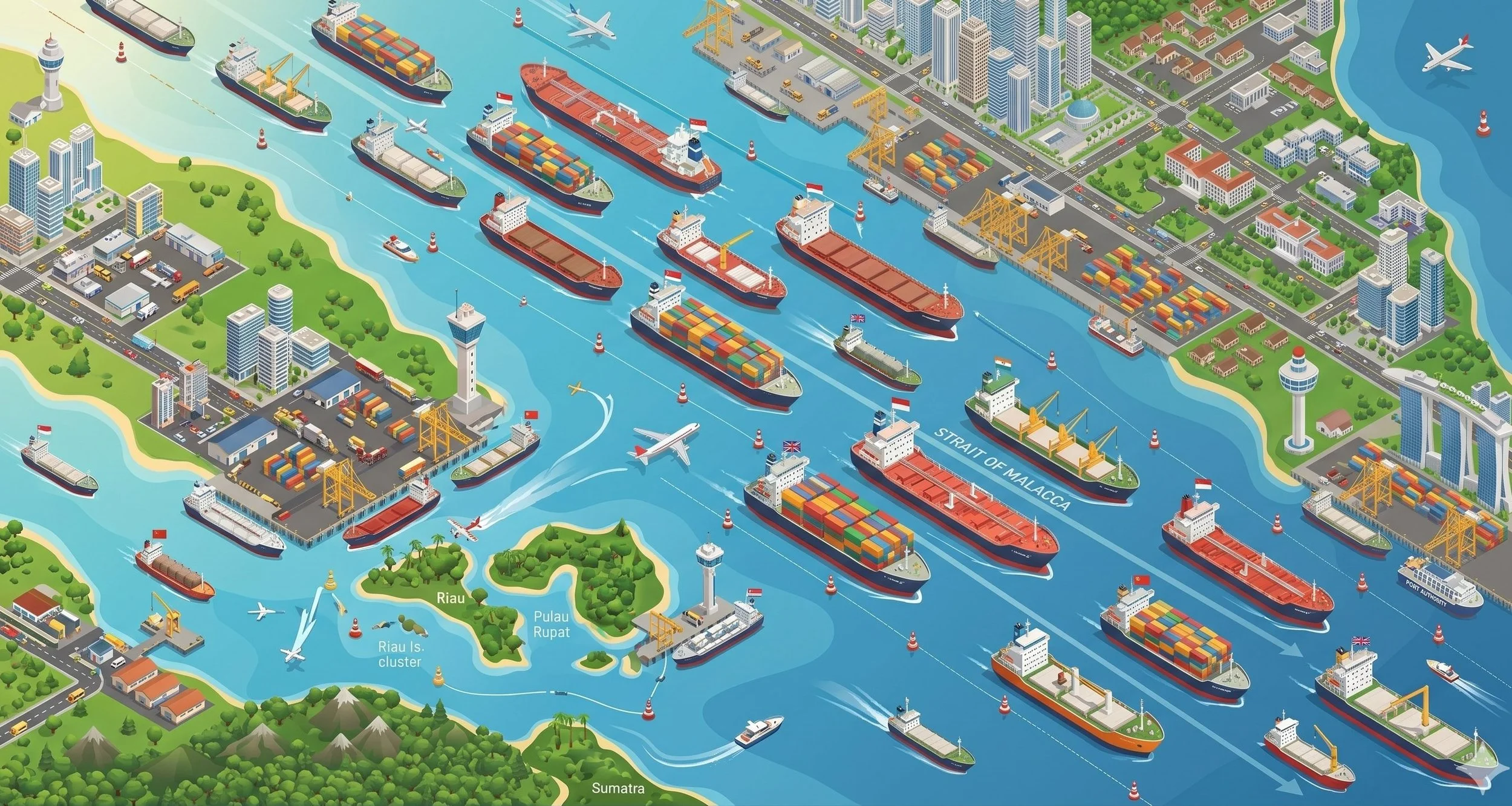
Illustration: The world's primary trade gateway. This depicts the bustling activity of the Strait of Malacca, the most strategic maritime route connecting Asia's economy to the rest of the world.
In the conflict between Iran and the United States, many observers still read China through the lens of Western chess. They look for direct moves: when China will step in, when China will pressure Washington, when China will openly defend Tehran, or when Beijing will provide visible support. When no frontal move appears, some conclude that China is passive, confused, or merely waiting.
But perhaps the problem is not that China is passive. Perhaps the problem is that we are reading the game with the wrong board.
China is not playing Western chess.
Xi Jinping is playing xiangqi, Chinese chess.
The difference matters. In Western chess, the game revolves around the logic of checkmate. The opponent’s king must be trapped, the center of the board must be controlled, and powerful pieces such as the queen and the rooks are used to apply direct pressure. It is more frontal, more deterministic, and easier to read as a contest between two centers of power.
Xiangqi is different. Its board is divided by a river. There is a palace that the general cannot leave. There is a cannon that cannot capture unless another piece acts as a screen. There is an elephant that is strong defensively but cannot cross the river. There is a horse that is agile but can be blocked. There are soldiers that look weak at first, but become more dangerous once they cross the river. The objective is not merely to deliver a quick checkmate, but to shape space, impose costs, use intermediaries, and force the opponent to keep moving from a position of disadvantage.
This is the more accurate way to read China’s movement in the Iran–America conflict.
Reading China’s Real Game
On Beijing’s xiangqi board, Iran is not the general. The general is China’s own core interest: Party stability, energy security, Taiwan, the South China Sea, industrial supply chains, and domestic economic resilience. Iran is not the center of the game. Iran is a forward piece, useful because it can make every American move more expensive.
The river in the middle of the board is the Strait of Hormuz. On paper, Hormuz is an energy route. But in the logic of xiangqi, Hormuz is a space that can change the value of every piece. When Iran pressures Hormuz, energy prices rise. When America responds with a blockade, Iran is squeezed, but the world is squeezed as well. Energy importers such as Indonesia, India, Japan, South Korea, and European countries all pay the price. This is how xiangqi works: pressure on the river can alter the entire board.
If China is the general, then Iran is the cannon. In xiangqi, a cannon cannot capture directly. It needs another piece to serve as a screen. In geopolitics, that screen can take the form of anti-intervention narratives, oil markets, shipping lanes, diplomatic forums, or Global South resentment against Western dominance. China does not need to be seen firing the shot. It only needs to allow Iran to create pressure that forces America to respond. Once America responds too aggressively, global costs rise, and Washington begins to look like a coercive power making the rest of the world suffer.
The soldiers are the small instruments that keep moving forward: energy trade, industrial components, dual-use technology, logistics routes, alternative payment systems, port cooperation, and economic relationships that may not look spectacular but accumulate over time. China does not design victory through one dramatic explosion. It wins through small movements that gain more value after crossing the “river” of crisis.
The elephant is China’s defensive doctrine: sovereignty, non-intervention, regional stability, and peaceful settlement. China uses this language to appear as a guardian of order rather than a provocateur. But in xiangqi, the elephant does not cross the river. This means China will defend principles that serve its position, but it will not sacrifice its palace for Iran. Beijing will support Tehran as long as Tehran is useful, but China will never become Iran.
The horse is regional diplomacy: Russia, Pakistan, Oman, the Gulf states, BRICS, the SCO, and indirect communication channels. The horse does not move in a straight line; it jumps into unexpected spaces. But it can also be blocked. That is why China keeps many doors open, many forums alive, and many partners engaged. If one route is closed, another remains available.
The chariot is infrastructure and economics: the Belt and Road Initiative, ports, refineries, shipping, energy, manufacturing, and markets. It is a powerful straight-line piece. China does not need to deploy a battle fleet to show influence if supply chains, financing, and market access already make many countries think twice before opposing Beijing.
Why Trump’s Moves Make China Look More Dominant
Trump, meanwhile, plays with the logic of Western chess. He sees Iran as the king that must be checkmated. Israel and its allies become the striking queen. The blockade becomes the rook. Sanctions become the knight. Trump brings multiple queens onto the board to pressure Iran. The objective is clear: force Iran to retreat, suppress its nuclear program, break its military capacity, make the Iranian king surrender, and send a message to China that America can still win on the Western chessboard.
But this is where the difference between the two games becomes decisive. In Western chess, a powerful move is often considered the best move. In xiangqi, a powerful move can become a trap if it pulls the opponent onto a board that has already been prepared. America can strike Iran. But every strike can raise oil prices, drain ammunition, divert attention from the Indo-Pacific, unsettle allies, and allow China to appear calmer and more strategic.
In other words, China does not need to defeat America in the Middle East. China only needs to turn every American tactical victory into a strategic burden.
Where Does Indonesia Stand?
This is where Indonesia must read the game more carefully. Not because Indonesia seeks to replace America or China as a great power, but because Indonesia is one of the countries that will pay the price if Hormuz continues to be used as a hostage-taking tool. Rising oil prices are not an abstract theory for Indonesia. They mean pressure on the state budget, energy subsidies, inflation, the rupiah, logistics costs, and household purchasing power.
Indonesia’s response cannot remain merely normative. It is not enough to say that Indonesia “encourages peace” or “calls for de-escalation.” Those statements are correct, but they are not sufficient. Indonesia must build a more operational position: reject escalation, reject blockades that suffocate global trade, and reject the use of chokepoints as instruments of strategic extortion.
Indonesia must also build an economic and maritime firewall. Its territory must not become a grey channel for dual-use goods, suspicious transactions, dark shipping, or conflict logistics. This is essential so that Indonesia does not become the screen for anyone’s cannon.
At the same time, fiscal and energy resilience must be prepared. If Hormuz remains disrupted, Indonesia needs oil price scenarios, energy stock strategies, supply diversification, and clear fiscal communication to the market. Stability is not merely the absence of panic. Stability is the ability to show that the state has a plan.
The Strait of Malacca as a Strategic Card
The Strait of Malacca is not Hormuz. Hormuz is vital for energy. But Malacca is an energy route and, at the same time, a route for manufacturing, containers, raw materials, electronics, commodities, and the economic pulse of Asia. If Hormuz is the oil tap, Malacca is the bloodstream of global trade. That is why Malacca’s strategic value may be greater than Hormuz. Malacca is Hormuz and Suez combined.
But the Malacca card must not be played crudely. Indonesia cannot impose a rule that every passing ship must pay a tax. Under international maritime law, including the principle of transit passage under UNCLOS, international straits cannot be treated as unilateral toll gates. Hormuz is also subject to similar legal debates, although its position is more complicated because both Iran and the United States have not ratified UNCLOS and often interpret navigational rights differently. In general, however, the widely recognized principle remains the same: international shipping lanes cannot be arbitrarily obstructed by coastal states.
This is why Indonesia’s maneuver must be more elegant. Not “closing Malacca.” Not “taxing passing ships.” Instead, Indonesia should invite Malaysia and Singapore to build a common position: if the world wants the Strait of Malacca to remain open, safe, and stable, then the world must help pay for that stability.
This is burden sharing, not a toll fee.
The packaging is maritime security contribution, not a transit tax.
The message is stability of navigation, not chokepoint extortion.
Indonesia, Malaysia, and Singapore can say to the world: we respect UNCLOS, we uphold freedom of navigation, but maritime safety does not emerge from empty promises. Patrols must be funded. Radars must be installed. Search and rescue must be maintained. Oil spill risks must be managed. Piracy, smuggling, cyber-maritime threats, and the spillover risks of major-power conflict must be addressed. If user states such as China, Japan, South Korea, India, the United States, and Europe benefit from Malacca’s stability, then their contribution to Malacca’s security must be increased.
This is how to “hostage” without becoming hostile. Not by shutting the door like a bouncer, but by making the world understand that even an open door requires shared costs. If Hormuz continues to burn the global economy, then Malacca must be treated as a global public good that requires global financing.
In this way, a Malacca maneuver would not be an imitation of Iran. It would be a correction to a world that speaks too easily about freedom of navigation, yet remains too reluctant to pay for stability of navigation. It would also send a message to both America and China that countries around chokepoints are not merely transit corridors, not mere spectators, and not empty spaces to be used in great-power games.
Conclusion
The Iran–America conflict cannot be understood merely as a war between Washington and Tehran. It is also China’s xiangqi board. Xi Jinping does not need to move frontally to make America struggle. He only needs to keep his general safe, use Iran as a cannon, turn Hormuz into the river, move economic soldiers forward step by step, and let America exhaust itself on the wrong board.
On a board like this, victory does not always look like victory. America can strike Iran, but every strike can raise oil prices, disrupt supply chains, drain ammunition stocks, divert attention from the Indo-Pacific, and give China room to appear composed. Iran can be pressured, but that pressure rebounds into global markets. Hormuz can be blockaded, but the world feels the choke.
This is where the Strait of Malacca becomes more than a sea lane. It becomes a mirror for the world, showing that chokepoints are never neutral. Hormuz shows how a single energy route can shake the global economy. Malacca shows something even larger: that global trade has long rested on a form of stability that many have treated as free.
That is why Malacca must be played rationally. There is no need to close the strait. There is no need to announce a transit tax. There is no need to imitate Iran. The real strength of Malacca lies in its ability to remain open while making all parties understand that openness requires cost, trust, and shared responsibility.
If the world does not want chokepoints to become weapons, then it must stop treating them as free promises while coastal states bleed from the consequences of aggression elsewhere. If Hormuz burns, Malacca and its coastal states must also be protected. All user states must share the cost of stability so that Malacca does not become the next arena of global conflict.
At this point, Indonesia does not need to become America’s pawn. Nor does it need to become the screen for China’s cannon. Indonesia simply needs to stand as a maritime state that understands the board, understands the routes, and understands that in this century, power is not determined only by who has the largest warships, but by who can read when the sea is a trade route, when it becomes an instrument of pressure, and when it must be turned into a negotiating table.
Because in Western chess, players seek checkmate. In xiangqi, players make the opponent lose through space, cost, and miscalculation. But in the maritime politics of an archipelagic state, the best game is not to chase checkmate or set traps. The best game is to make sure the board is never played on top of our own body.