

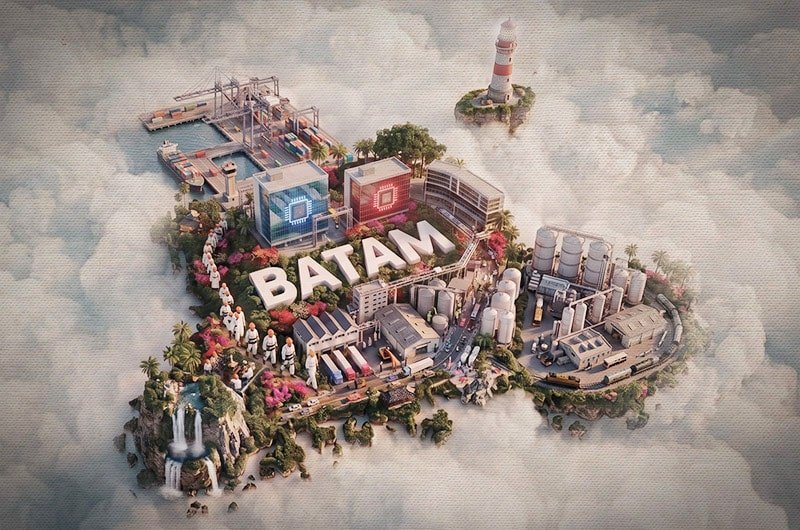
The 21st-century cold war is no longer confined to the Taiwan Strait, the South China Sea, or trade negotiation tables. Its true battleground has shifted to something far smaller in physical scale, yet decisive for the future balance of national power: semiconductors, data centres, energy, and compute.
Washington is fighting to preserve its technological edge by restricting access to the most advanced AI chips. Beijing, in turn, is racing to build out its own computing ecosystem while extending its digital infrastructure abroad. The United States, for its part, continues to enforce tight controls over the use and transfer of advanced computing technology to ecosystems it deems high-risk; Chief among them, China.
Yet several thousand kilometres from both Washington and Beijing, an anomaly is quietly taking shape barely a few dozen kilometres from Singapore. In Nongsa, foreign capitals and international infrastructure from two increasingly estranged technology ecosystems are beginning to lay their foundations on the very same soil; Not because their rivalry is cooling, but because in an ever more fragmented world, both sides have found sound economic reasons to trust the same location.
This is where Batam begins to resemble “Switzerland” in the AI Cold War. It isn’t a politically neutral territory, nor as a zone free from technology-control regimes, but as neutral ground for foreign capitals, able to absorb investment from competing poles without pledging exclusive allegiance to either.
Beyond Singapore’s Overflow
The simplest illustration for Batam’s outsized potential is to call it Indonesia’s windfall from Singapore’s data-centre constraints. That explanation may have held some truth a few years ago; today, it is far too simplistic.
Singapore itself is not retreating from the data-centre industry. Quite the opposite: its government has reopened room for growth through the Green Data Centre Roadmap, albeit under increasingly stringent conditions on energy use, efficiency, and sustainability. In other words, Singapore is not exiting the business, it is becoming more selective about which industries may draw on its scarce land and resources.
And the more selective Singapore becomes, the more room opens up for Batam to offer something a city-state simply cannot: scalability.
Batam is not a substitute for Singapore. Its strength lies precisely in its capacity to serve as an extension of that ecosystem. Singapore can retain its role as a financial hub, connectivity node, and provider of premium digital services, while Batam supplies land, power, and room for expansion on a far larger scale.
That relationship has become concrete through the Nongsa–Changi Cable. This roughly 50-kilometre subsea cable system, which made landfall in Batam in July 2026, carries a capacity exceeding 1.6 petabits per second and ranks among the shortest direct connections between Nongsa and Changi. Once fully operational, it will further blur the digital boundary between the two territories. Administratively, Batam remains Indonesian and Changi remains Singaporean—but in data architecture, the two are beginning to resemble parts of a single ecosystem.
Batam’s emergence as a digital-economy node has also gained legitimacy at the highest bilateral level. At the Singapore–Indonesia Leaders’ Retreat held in Jakarta in July 2026, President Prabowo Subianto and Prime Minister Lawrence Wong discussed the development of the Batam, Bintan, and Karimun corridor as a new growth space for bilateral cooperation.
Wong openly described the corridor as evolving into a digital hub drawing interest from major investors, while both governments began exploring fresh opportunities in advanced technology and the digital economy. The most important signal from that meeting was not merely that Singapore acknowledges Batam’s potential—it is that the city-state does not appear to view Batam as a rival to be contained. If anything, Batam is increasingly positioned as a strategic hinterland capable of expanding Singapore’s digital capacity beyond the limits of its own geography.
AI As a Heavy Industry
In yesterday’s digital economy, data was the primary commodity. Artificial intelligence has rewritten that equation: modern compute centres no longer require just data and chips, but electricity on a scale once associated exclusively with heavy industry.
Thousands of GPUs running in parallel generate extraordinary amounts of heat. The larger the AI models being trained and deployed, the greater the demand for power, cooling, networking, and infrastructure redundancy. The race to build AI hubs, then, is no longer solely a contest for the most advanced chips. It is a race to secure vast quantities of energy at predictable prices and with reliable certainty of supply.
This is where the scale of Batam’s ambition becomes visible. In April 2026, DayOne signed a long-term power supply agreement with PLN Batam for 511 MVA—roughly 450 MW—to develop its data-centre campus in Kabil. That supply will be delivered in phases throughout the 2026 and 2027.
That figure of 450 MW offers a useful gauge of the shift underway. Batam is no longer simply preparing a handful of server-filled buildings; it is building the energy infrastructure for hyperscale computing facilities. In the AI economy, data still matters, but AI, ultimately, is also an energy business.
That euphoria, however, comes with a significant caveat. Batam carries one vulnerability that represents the sternest test of its ambitions as a regional computing hub: water.
The island depends heavily on reservoirs and rainfall for its raw water supply, while conventional data centres require enormous volumes of water to dissipate heat from thousands of servers. The growth of compute facilities cannot be measured by available megawatts alone. It must also account for whether that growth can proceed without competing against the water needs of local communities and other industries.
That constraint places Batam’s future squarely in the hands of cooling technology. Closed-loop cooling, direct liquid cooling, and increasingly efficient thermal design can reduce reliance on water-intensive cooling methods. Firmus, for instance, is currently developing its liquid-cooled HyperCube platform for its AI campus in Batam.
The strategic question for Batam, then, is no longer whether the island has access to cheap water. The critical question is whether Batam can build an AI industry that remains competitive while using as little water as possible.
The Jakarta's Backing
Good infrastructure counts for little if global capital is left waiting years for land disputes, permitting delays, and overlapping jurisdictional authority to be resolved.
In July 2026, President Prabowo Subianto summoned the leadership of BP Batam. His message went beyond the development of a single industrial zone. It concerned Batam’s standing as a maritime gateway, logistics hub, magnet for global investment, and one of the engines of national economic growth.
For global investors, that political signal matters, because Indonesia’s investment challenges have rarely stemmed from a shortage of projects or investor interest. The trouble typically emerges once ready capital collides with execution risk: unresolved land titles, permits stuck awaiting one another, spatial planning that has yet to be synchronised, and institutions holding differing interpretations of their own authority.
Those challenges were on full display a few months earlier, when Finance Minister Purbaya Yudhi Sadewa chaired a Debottlenecking Session that examined investment barriers in Batam, including land-use permit (KKPR) issues, land-status disputes, and gaps in inter-agency coordination.
The real significance of that mechanism lies in how the Indonesian government now treats investment bottlenecks. When billion-dollar projects get stuck between bureaucratic desks, such obstacles are no longer treated as routine inter-directorate correspondence. They are escalated directly to decision-makers and forced toward resolution.
Global investors are not always looking for the country with the fewest regulations. More often, they are looking for the country that can offer certainty: who makes the decision, how long it takes, and what happens when a problem arises. In today’s fast-pace economy, the ability to provide answers has become just as valuable as fiscal incentives.
From Gatekeeper to Investment Concierge
That shift in posture must ultimately be translated on the ground by the operator: BP Batam. This is the decisive stage, because agencies managing investment zones can easily slip into the role of gatekeeper: over cumbered with checking documents, issuing permits, and explaining prohibition to investors.
The approach taking shape in Batam points the other way. Through its Investment Dashboard, investment clinic, and network of Investment Ambassadors, BP Batam’s investment functions are being redirected toward monitoring investor pain points and accelerating cross-agency follow-through.
The concept is simple, yet its implications are radical for Indonesia’s bureaucratic tradition. Investors should not be forced to navigate the labyrinth of government authority simply to deploy their capital. Under the investment-concierge model, it is the government that must organise its own complexity, so that investors face a system capable of delivering answers, not a maze they must decode themselves.
Physical facilities and permitting ease are not the only bottlenecks. AI factories require technicians, cloud engineers, network specialists, cybersecurity experts, and infrastructure operators trained to international standards. Batam does not yet possess a talent pool as deep as Singapore’s, meaning that digital-industry expansion at the scale of hundreds of megawatts will hinge heavily on how quickly local labour can catch up with the technology’s demands.
That is why the presence of the Apple Developer Academy, the IBM Academy for Hybrid Cloud and AI, and various educational partnerships in Nongsa amount to more than branding exercises for the zone. These programmes form the embryo of a talent pipeline that can gradually reduce dependence on foreign expertise.
Their scale and depth are not yet sufficient to sustain the full needs of Batam’s AI industry, but the direction is right. A country can buy GPUs, erect buildings, and attract foreign investors—but it will never achieve depth in the digital economy if its own people remain mere spectators. In the long run, there is no sovereign compute without sovereign talent.
Two Ecosystems, One Island
The clearest evidence of this entire orchestration is not found in government buildings or policy documents. It is found in who is actually showing up.
From China, PT Equator Gate System Batam, backed by Range Intelligent Computing Technology, is developing a high-density AI data centre on roughly 30 hectares in Nongsa, with committed investment of approximately US$5 billion, or Rp88 trillion. Batam also marks RangeIDC’s first international expansion outside China; A decision suggesting the island is now viewed not merely as an Indonesian market, but as a regional platform.
Then there is an entirely different ecosystem. Australia’s Firmus Technologies is building an AI campus alongside DayOne, a Singapore-headquartered digital-infrastructure company, with NVIDIA as its strategic technology partner.
Firmus has announced a dedicated 360 MW NVIDIA DSX AI Factory campus in Batam. Its partnership with NVIDIA runs through 2034 and encompasses up to 170,000 NVIDIA AI accelerators spanning the Grace Blackwell, Vera Rubin, and Vera generations, to be deployed across 2027 and 2028. Based on customer commitments secured so far, Firmus projects committed offtake agreements worth between US$25 billion and US$30 billion over the first six years.
The resulting constellation is striking: Chinese capital and infrastructure land in Nongsa; NVIDIA enters through the Firmus–DayOne ecosystem; Australia brings the engineering; Singapore supplies connectivity and business networks. Indonesia itself becomes the host where all of it converges.
This convergence matters not because the world has suddenly grown more harmonious. Its significance stems from precisely the opposite: the world is growing more fragmented.
Batam is not a zone where American chips can be freely used by anyone. Washington continues to control certain advanced computing technologies and remains particularly alert to the possibility of their diversion toward entities deemed to have strategic ties to China.
That means the various ecosystems taking shape in Batam are likely to operate behind clear fences—separated by technology, customers, data, networks, and export-compliance regimes. NVIDIA and RangeIDC can coexist on the same island without ever sharing the same technological system.
Herein lies Batam’s strategic appeal: rivals need not share chips to share geography, nor must they trust one another to invest in the same location.
The United States brings one of the world’s most advanced AI-computing ecosystems. China brings capital and ambitions to expand its digital infrastructure abroad. Singapore brings connectivity, finance, and decades of data-centre operating experience. Australia brings engineering and AI-factory design. Indonesia supplies the land, power, jurisdiction, workforce, and political access that allow all of this investment to function.
Batam, then, is not trying to determine who wins the AI Cold War. It is angling for a more advantageous position altogether: becoming the place where rival powers still have reason to do business with one another. The bottom line is that Batam is not a site of technological neutrality in any political sense, it is something more pragmatic than that.
The Next Big Thing
Even so, Batam’s success should not be celebrated prematurely. The megawatts announced are not yet the megawatts actual operating. Investment commitments do not yet mean capital fully deployed. The talent pool must grow far faster, and the water question must be resolved before digital-industry growth collides with the needs of local communities.
Such are the real test. Building a handful of data centres can be accomplished within a few years; building a computing ecosystem capable of enduring two or three decades demands policy consistency.
For the first time ever, all the necessary pieces appear to be converging in Batam: direct connectivity to Singapore, room still available for expansion, power contracts at the scale of hundreds of megawatts, an emerging talent pipeline, and central-government intervention whenever bottlenecks arise. Most striking of all, this entire ecosystem is drawing capital from technology worlds that are, geopolitically, drifting further apart.
Batam does not need to defeat Singapore, nor does it need to outrace Johor. Singapore can remain the region’s premium financial and digital centre; Johor can continue building hyperscale campuses at massive scale; Batam, meanwhile, can carve out a distinct position as the meeting point between compute capacity, the Indonesian market, Singaporean connectivity, and global capital.
If Indonesia can safeguard legal certainty, power supply, water availability, talent quality, and execution speed, Batam could evolve from an industrial zone that merely happens to sit beside Singapore into one of Asia’s new strategic nodes on the computing map.
And perhaps that is where Indonesia’s greatest asset in the AI Cold War truly lies: not in its ability to manufacture the most advanced chips, nor in picking the side that will eventually win the technology race, but in its capacity to offer a place secure enough, efficient enough, and strategic enough that two mutually distrustful ecosystems still choose to show up and coexist.
In the end, this strategy’s success does not even require Washington and Beijing to trust each other. Batam needs only something far more attainable: getting both of them to trust Batam.