
Bretton Woods Made in China: Why Trump Came to Beijing with Wall Street Squad

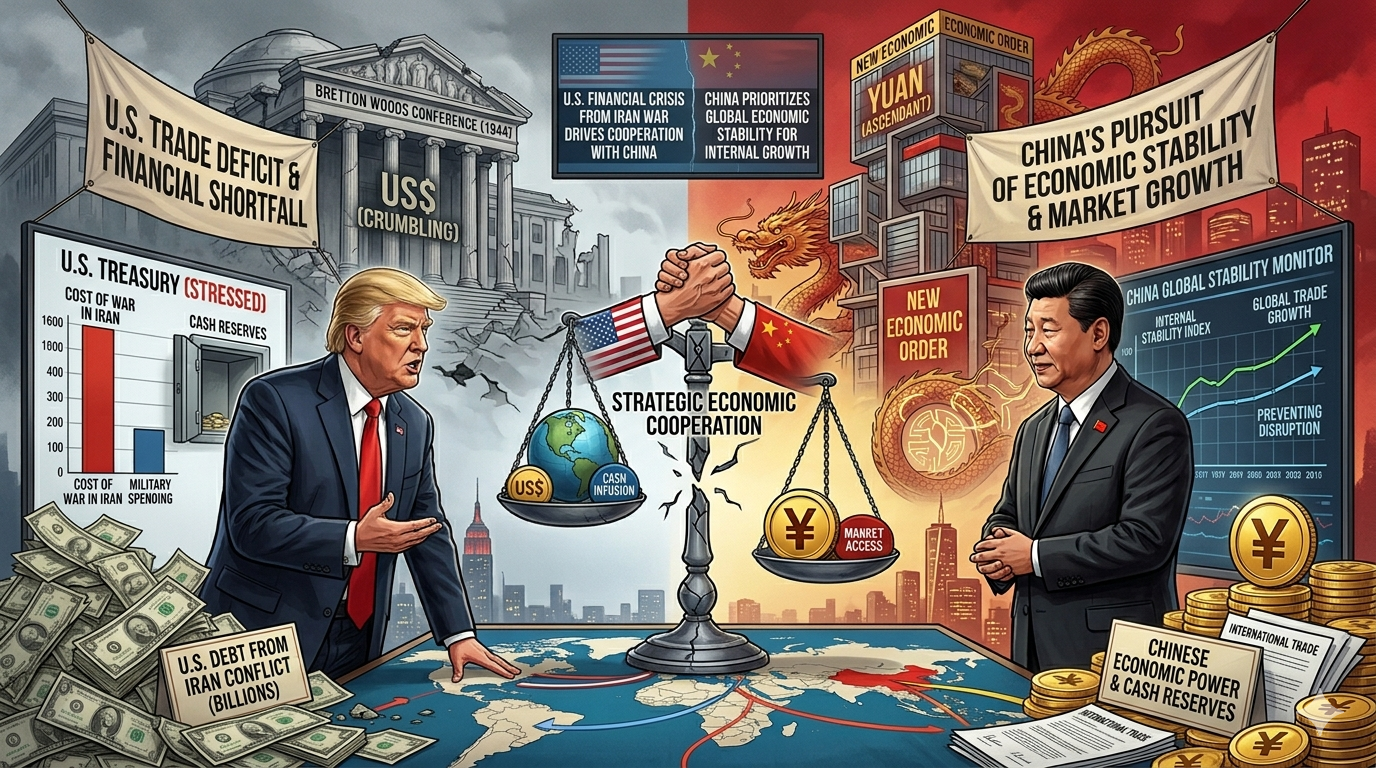
Donald Trump’s visit to Beijing was never just another round of trade diplomacy. It was a meeting between China’s historical wounds, Trump’s political ego, and the future of global capitalism. Trump did not arrive in Beijing with aircraft carriers, missiles, or lectures about democracy. He came with all Wall Street big time players. The message was clear: China may remain rich, powerful, and central to the world’s production system. But China must not become the financial quartermaster of Russia and Iran.
On the surface, the visit looked like a normal bilateral summit between the world’s two largest powers. There was trade, there was technology, there was Tehran and there was Taiwan. There were American CEOs seeking wider access to the Chinese market.
But beneath the surface, something much bigger was taking shape. Trump was trying to build a strategic barter: America gives China room for capital, investment, and market access, while China helps preserve global stability so that Iran, Russia, energy prices, and Hormuz do not burn down the remaining years of Trump’s presidency.
This is where Trump seems to learn from Nixon, but with a very different instrument. In 1972, Richard Nixon went to China to exploit the fracture between Beijing and Moscow. Washington understood that the best way to weaken the Soviet Union was not merely to pressure China, but to pull China away from the Soviet orbit. Nixon’s visit opened a new strategic balance in the Cold War. America gave Beijing geopolitical recognition and helped bring the People’s Republic of China into the center of the international system.
Nixon brought diplomacy, Trump brought Wall Street
Nixon wanted to split the communist bloc. Trump wants to prevent China from becoming the banker of the anti-Western axis.That is the core of this visit. Trump is not asking China to become America’s ally. That would be naive. His objective is more realistic. He wants China not to go too deep in helping Iran and Russia. He wants Beijing not to accelerate de-dollarization too aggressively. He wants the yuan not to become an escape route for states under Western pressure. Most importantly, he wants China not to let Hormuz become a black hole that drags energy prices, inflation, and global markets into chaos.
Would China be interested? Of course. Not because Xi Jinping trusts Trump, but because Trump’s offer touches China’s own vulnerabilities. China still needs energy. China still needs secure maritime routes. China still needs export markets. China still needs access to advanced technology, especially in chips and high-end supply chains. China may be the world’s factory, but even the world’s factory still needs fuel, shipping lanes, customers, and technology.
Trump’s offer to Xi therefore comes in two major packages. The first is greater access to markets, investment, and production opportunities. If China becomes more aggressive in penetrating the American and global markets, American investors with exposure to China will also benefit. This is not anti-China. This is profit-sharing in China’s rise. If China can no longer be defeated as the world’s factory, then Wall Street must at least own a stake in that factory machine.
The second offer is more political. Trump is indirectly asking China to help protect Trump himself. This is the most important part. The Iran-Hormuz crisis could become a political bomb for Trump. If Hormuz is disrupted, energy prices rise. If energy prices rise, inflation worsens. If inflation worsens, markets panic. If markets panic, Trump looks like a president who created a crisis he can no longer control.
This is where China matters. Beijing has influence over Iran. It also has a direct interest in keeping the Strait of Hormuz open, because that route is vital for global energy flows and for China’s own energy security. China is not merely watching from the sidelines. It is one of the few actors capable of easing, or at least managing, one of the most dangerous pressure points in the global economy.
So the grand bargain becomes clear: Trump sells market access. Xi sells stability. But China will not accept Trump’s offer innocently. Beijing will take the benefits, but hold back its commitments. China will say it supports global stability, but not because Trump ordered it to do so. China may help calm Iran if it also serves China’s interest. But Beijing will demand a price, especially on Taiwan, chips, tariffs, technology, and recognition of China’s status as a great power.
For Beijing, Taiwan is not just a diplomatic issue. It is a civilizational red line, a domestic political question, a chip-security question, and a pillar of Xi Jinping’s national legitimacy. This is why the real question is not whether China will accept Trump’s deal. The real question is: how expensive will China make the deal?
Bretton Woods Made in China, or For China?
The West fears that China is building a rival system. That fear is not entirely wrong. But it may misunderstand China’s original intention. China may not have started with an ideological dream of replacing the dollar or dismantling Bretton Woods. China simply needed to keep producing. It needed to build factories. It needed to build ports. It needed to dominate supply chains. It needed to expand its state-owned banks. It needed to sell goods to Europe and America. Yet from that seemingly simple motive, a new system began to emerge. Not a Bretton Woods born from a conference, but a Bretton Woods born on the factory floor.
The Western Bretton Woods was built on the dollar, the IMF, the World Bank, and the architecture of the post-World War II order. China’s Bretton Woods is built on containers, ports, state banks, Belt and Road, rare earths, electric vehicles, batteries, solar panels, and the West’s dependence on Chinese manufacturing.
China does not need to drain Europe’s gold vaults. It only needs to sell cheap goods to Europe and America for decades, while allowing the West to repay history through trade deficits, invoices, containers, and supply-chain dependence.
If Western colonialism once moved Asian wealth to Europe through cannons, opium, trading companies, and unequal treaties, China today is moving wealth back through mass production. This is not merely economics. For China, it is the restoration of a historical balance sheet. That is why it is always personal.
In China’s historical memory, Britain is the wound of the Opium Wars, treaty ports, Hong Kong, and unequal treaties. Japan is the wound of invasion, Manchuria, and the trauma of the twentieth century. So when Trump appears less deferential toward Britain and Japan, Beijing notices something important: Trump is not the typical Western leader who automatically embraces China’s historical adversaries with sacred loyalty.
In front of Britain, Trump can joke with an old empire. In front of Japan, Trump can perform dominance. But in front of Xi, Trump lowers his tone. He arrives with CEOs, deals, and respect. For China, that is not a small detail. In Beijing’s political culture, public respect is the first installment of historical recognition.
Trump’s strategy toward Xi is therefore not only economic. It is also civilizational psychology.Trump knows China cannot be subdued through humiliation. Xi will not accept any deal that makes China look defeated. So Trump offers Xi a dignified exit: China can remain sovereign, powerful, majestic, and rhetorically anti-hegemonic, while becoming more cautious in helping Iran and Russia.
China will welcome American investors because it benefits the Chinese economy. China will support keeping Hormuz open because it needs energy security. China will keep communicating with Trump because it gives China economic breathing space.
But China will not openly cut off Iran and Russia. It will not become America’s junior partner. It will not provide help for free without demanding concessions on Taiwan, technology, tariffs, and market access.
Xiangqi and the Strategy of Waiting
The author previously wrote an article titled “Xiangqi: How Xi Jinping Reads the Iran War.” In that article, China’s best strategy was not to openly help America’s enemy. Beijing only needed to keep its distance, read the board, and let Washington pay for its own mistakes: war costs, energy pressure, inflation, shipping disruption, and the chaos of Hormuz.
That was a patient xiangqi strategy. You do not need to kill your opponent. You only need to let your opponent make the wrong move. But Trump came to Beijing to disrupt the comfort of that strategy. He brought Wall Street so that China could no longer remain merely a spectator enjoying America’s mistakes. Trump wants China to have a stake in stability. If Hormuz burns, China loses. If Iran goes too far, China loses. If Russia becomes more desperate, China loses. If Western markets close themselves off, China loses. In other words, Trump is inviting China to recalculate.
This is where the theory of Greedy Neutrality Strategy is born. Trump does not need to make China pro-American. He only needs to make China too rich to gamble everything with Iran and Russia. America does not need to change China’s ideology. It only needs to make China calculate that maintaining economic ties with the West is more profitable than becoming the banker of the anti-Western axis.
For Trump, this is pure calculation. If China cannot be stopped as a production power, then China’s growth must remain connected to the interests of American investors. If China cannot be forced to become an ally, then China must at least become too invested in stability to burn the global system alongside Iran and Russia.
For Xi, this is not about trust in Trump either. It is an opportunity. China can accept markets, investment, technology, and strategic respect without appearing submissive. China can help ease tensions in Hormuz without calling itself America’s assistant. China can play the role of global stabilizer while still charging Washington a political price.
Xi Shows Trump the Age of China
One symbolic moment captured the deeper meaning of the visit. After discussing trade, Taiwan, and Iran, Xi brought Trump into Zhongnanhai, the closed political compound at the heart of Chinese power. It is not simply an office complex. It is a former imperial garden, located near the Forbidden City and Tiananmen Square. It is one of the most sensitive centers of Chinese political authority.
There, Xi showed Trump ancient trees, some hundreds of years old. He reportedly told Trump that some trees were 200 to 300 years old, some more than 400 years old, and others perhaps even older. Trump, surprised, asked whether they could really live that long.
This was not just a casual walk in a garden. It was civilizational theater. Trump came to Beijing with the clock of Wall Street: markets, quarterly earnings, Boeing orders, Nvidia chips, energy prices, and the remaining years of his presidency. Xi answered with the calendar of Chinese civilization. Trees that outlived empires. A political compound rooted in imperial memory. A state that measures time not only in election cycles, but in centuries.
Xi was not showing off trees. He was showing off time. The message was subtle but unmistakable: you come with deals; we come with history. You come with Wall Street; we come with civilization. You count years; we count dynasties.
This is why China will not be bought cheaply. It can be persuaded. It can be engaged. It can be tempted by profit. But it will not allow profit to become a new form of dependence.
Trump may offer Nvidia. Xi will still think of Huawei. Trump may offer Boeing. Xi will still think of Comac. Trump may offer Wall Street. Xi will still think of state banks, industrial policy, and China’s long road toward technological sovereignty.
China wants to be rich, but it does not want to be rich by American permission. That is the limit of Trump’s Greedy Neutrality Strategy. Trump wants to make China too rich to die with Russia and Iran. Xi wants to make sure China does not become too dependent on America in order to stay rich.
Conclusion
Trump’s visit to Beijing is not about who submits to whom. It is about two great powers buying time. Trump needs the remaining years of his presidency not to be drowned by Iran, Hormuz, energy inflation, and a wider war. Xi needs the next few years to protect China’s economy, energy security, chip ambitions, export markets, and national dignity.
Trump did not come to Beijing to buy China. He came to make China too invested in stability to die with Russia and Iran. China, at the same time, did not come to save Trump. China came to raise the price of Trump’s safety.
In Beijing, Trump sold market access. Xi sold stability. And the world now waits to see whether Bretton Woods Made in China will become a rival system to the West, or a new dining table where Wall Street is allowed to enjoy Beijing’s rise. The answer may come when Xi Jinping visits Washington in September 2026.