

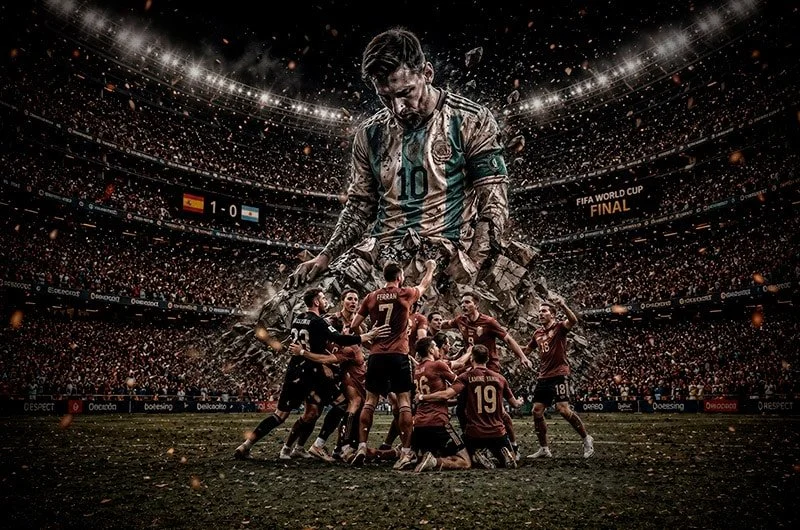
There are years when history is shaped by elections, wars, markets turnmoil, and revolutions. Then there are years when it reveals itself through sport. In the first half of 2026, the signal was impossible to ignore: the age of the gods had not ended, but the gods were beginning to fall. For most of human history, sport has been our proving ground for strength, endurance, courage, and adaptability. From the ancient Greeks to soccer fields, sport has always been a place where human capability was tested under pressure.
There are years when history moves through elections, wars, markets, and revolutions. And then there are years when history speaks through sport. In 2026, the message was impossible to miss. The age of gods did not end. But the gods began to lose.
Lionel Messi still walked into the World Cup final as football’s last deity. America still stood with its aircraft carriers, satellites, stealth platforms, and global command architecture. Israel still carried the mythology of technological superiority. Paris Saint-Germain remained rich. New York remained New York. Arsenal remained one of England’s great institutions. Yet across stadiums, arenas, diamonds, cages, and battle maps, the same pattern kept repeating.
The most glamorous did not always win.
The most advanced did not always break the opponent.
The most marketable did not always own the script.
Again and again, 2026 belonged to those who refused to collapse.
It belonged to the unbreakables.
On July 19, in East Rutherford, New Jersey, football staged its final theological test. Argentina arrived with Messi, the defending champion’s aura, and the familiar theatre of destiny. For years, Messi had been more than a player. He had become football’s final sacred object, the global icon whom even neutrals felt history was obliged to protect. Among fans, the idea that FIFA and the wider football establishment had always wanted one last perfect ending for Messi had become an open secret. Not a legal brief. Not a courtroom claim. Something more powerful: a mythology of the terraces.
Argentina carried that mythology into the final. They also carried their dark arts: provocation, rhythm-breaking, emotional pressure, the ability to turn football into theatre and theatre into intimidation. But Spain did not come to play Argentina’s drama.
Spain came to win.
The game ended 1–0 after extra time. Ferran Torres scored in the 106th minute. Enzo Fernández was sent off. Messi searched for one last miracle, but this time the miracle did not come. Spain did not defeat him with rage. Spain defeated him with structure. With patience. With young legs. With second stars. With a system that had no need for divine intervention.
That was the deeper meaning of Spain’s victory. This was not Greece in 2004. Spain was not a small nation ambushing an empire. Spain is itself a footballing power. But the Spain of 2026 did not feel like a galactico project. It felt like a republic of workers: young, disciplined, technically ruthless, emotionally restrained, and almost allergic to melodrama.
Within that Spanish side, one could sense something older than modern football: the Basque ethic. The Basques are among Europe’s most ancient cultural communities, guardians of Euskara, a language often described as one of the last surviving pre-Indo-European tongues in Western Europe. Under Franco, Basque identity was repressed with force. Its language was pushed out of schools, publishing, administration, and public life. Its political expression was treated as a threat. Its cultural memory had to survive not as a slogan, but as discipline.
That is why the Basque presence around Spain’s triumph matters. It was not merely a matter of regional origin. It was symbolic. Players shaped by Basque footballing culture carried into Spain’s victory a certain austerity: no noise, no vanity, no need to be loved, only the obligation to perform. Against Messi’s mythology, Spain offered the old virtue of the workshop. Against Argentina’s theatre, Spain offered craft. Football’s god was not destroyed by an enemy. He was outworked by a republic.
The same story had already been written in New York.
For more than half a century, the Knicks had been a monument to longing. Madison Square Garden was the cathedral of a city that never stopped believing it deserved greatness, even when greatness refused to arrive. New York waited for saviours. LeBron. Durant. Zion. The next big name. The next commercial messiah. The next superstar who would make the city whole again.
But the 2026 NBA title did not come as a Hollywood rescue mission. It came through Jalen Brunson, a small guard who had once been dismissed as too short, too expensive, too limited, too unglamorous to become the centre of a championship universe.
Brunson became the commander. But the Knicks were never just Brunson. They were Josh Hart diving into the dirty spaces of the game. Mikal Bridges carrying the burden of a massive trade and turning doubt into utility. OG Anunoby defending without demanding the spotlight. Karl-Anthony Towns finding dignity not as a lone franchise saviour, but as a weapon inside a larger machine. Mitchell Robinson doing the unphotographed labour under the rim.
The Knicks were not beautiful in the way social media wants basketball to be beautiful. They were stubborn. Physical. Irritating. Difficult to kill. They carried the old New York grammar: elbows, bruises, second chances, and the refusal to be embarrassed by hard work.
They were the Pistons’ ghost rebuilt for a new age, but with Brunson as their cold-blooded closer. New York did not win because it finally found a god. New York won because it stopped waiting for one.
In Paris, the irony was even richer.
For years, Paris Saint-Germain had been football’s museum of ego. Neymar. Messi. Mbappé. Qatari money. Global branding. Infinite glamour. Repeated European failure. PSG became a warning: that wealth can assemble stars, but it cannot automatically create a team.
Then PSG changed. Under Luis Enrique, Paris stopped looking like a showroom and started looking like an organism. It pressed. It rotated. It controlled spaces. It learned to suffer without falling apart. It no longer revolved around one sacred figure. The poster had been replaced by the pattern.
Their Champions League defence in 2026, sealed on penalties against Arsenal, was therefore more than a trophy. It was a confession. PSG had needed to become less theatrical in order to become more dangerous. It had needed to bury the age of ornamental gods and accept the discipline of collective football. The club built by money finally learned that money was not enough. Culture had to do the rest.
Arsenal, even in defeat, belonged to the same year.
They lost the Champions League final, but 2026 still became the year Arsenal broke a different curse. After 22 years, they won the Premier League again. For a club that had spent two decades living between memory and mockery, that mattered. Arsenal had been told for years that they were almost ready, almost mature, almost champions. Too young. Too emotional. Too fragile. Too pretty. Too naive. Then they crossed the line.
That is why Arsenal’s place in this story is not about perfection. It is about persistence. The unbreakable is not the one that never falls. The unbreakable is the one that keeps returning after the fall has become part of its identity. Arsenal did not conquer Europe. But they conquered the waiting. In a year defined by refusal, that was enough to matter.
Across the Atlantic, Venezuela gave the year its sharpest geopolitical sporting image.
In the final of the World Baseball Classic, Venezuela defeated the United States 3–2. Eugenio Suárez delivered the decisive blow in the ninth inning. But Venezuela beating America in baseball could never be read as mere sport.
This was a country long framed through crisis, sanctions, pressure, stigma, and geopolitical hostility. Venezuela did not arrive as the preferred story of the Western media order. It arrived carrying resentment, pride, wounds, and memory. It did not defeat America through a speech. It defeated America with nerve. With defence. With a late hit. With the stubborn refusal to tremble before the centre of power.
If Spain was the republic of workers defeating a god, Venezuela was the Global South looking America in the eye and saying: we are still here.
Even the cage offered its minor echo. Sean Strickland beating Khamzat Chimaev was not the central drama of 2026, but it fit the pattern. Chimaev had been marketed as inevitability: undefeated, brutal, almost mythological. Strickland was rough, controversial, and deeply unpolished. Yet he survived long enough to crack the monster’s aura. It was not pretty. It was not noble. But it was very 2026. The myth met a man who refused to disappear.
Then came Iran.
If sport provided the metaphors, Iran provided the hard geopolitical reality. Iran is the real chapter of The Year of the Unbreakables. Spain, the Knicks, PSG, Arsenal, and Venezuela showed how systems, memory, labour, and discipline could defeat superstar mythology in sport. Iran showed the same principle under fire: an old civilisation refusing to lose simply because its enemies possess more advanced weapons.
America and Israel came with the language of technological dominance. Stealth aircraft. Drones. Satellites. Carrier groups. Precision strike networks. Aerial refuelling. Intelligence fusion. Cyber capabilities. The architecture of modern war.
Iran answered with something harder to measure.
Geography. Depth. Patience. Retaliatory capacity. Strategic ambiguity. Civilisational memory. Iran cannot be understood merely as a state apparatus or a regime. Iran is also Persia: one of the oldest civilisational memories on earth. It has seen empires arrive with confidence and depart with exhaustion. It knows that war is not only decided by who owns the sky. It is also decided by who remains standing after the sky has fallen.
In the technological imagination of the West, victory is often defined by precision: command centres destroyed, air defences suppressed, missiles intercepted, networks degraded, media narratives controlled. But in the imagination of an old civilisation, victory can be simpler and more brutal.
Iran does not need to destroy America to win psychologically. It only needs to refuse to break. Not surrendering is a message. Not disintegrating is a doctrine. Forcing a much larger adversary to recalculate the cost of escalation is itself a strategic achievement. And if, after all the threats, strikes, and shows of force, the stronger power must still return to the language of negotiation, then Iran has proven that superiority of weapons does not always equal superiority of will.
This is where Iran Join Spain.
Argentina brought Messi, mythology, and the belief that history owed one final page to its god. America and Israel brought technology, pressure, and the assumption that advanced force would bend Iran into submission. Spain and Iran, in vastly different arenas, answered with the same grammar: discipline, endurance, structure, and refusal.
One did it with sport. The other did it under fire. That is the larger meaning of 2026.
The world is tired of personality cults. For too long, we have been taught to believe that history is moved by gods: Messi, Mbappé, Neymar, NBA saviours, American military power, Israeli technology, the myth of inevitable dominance. But 2026 suggested another pattern. The winner is not always the most beautiful. The survivor is not always the most advanced. The hardest force to destroy is often the one that does not waste its strength worshipping itself.
The Knicks stopped waiting for a messiah. PSG stopped being a museum of egos. Arsenal rose after years of humiliation. Venezuela refused to bow before America. Spain defeated Messi not through hatred, but through structure. Iran refused to lose not because its technology was superior, but because it understood endurance as a civilisational language.
This was not the year the gods disappeared.
Messi remains Messi. America remains America. Israel remains technologically formidable. PSG remains rich. New York remains New York.
But 2026 taught a harsher lesson: names, money, narratives, and weapons are not always enough to break those who have learned how to suffer. In the end, the god was not defeated by a demon. He was defeated by a republic of workers.
And once a republic of workers learns how to suffer, it becomes one of the most dangerous forces on earth.