
The Myth of People's Game: 2026 World Cup Winner is the Global Elite

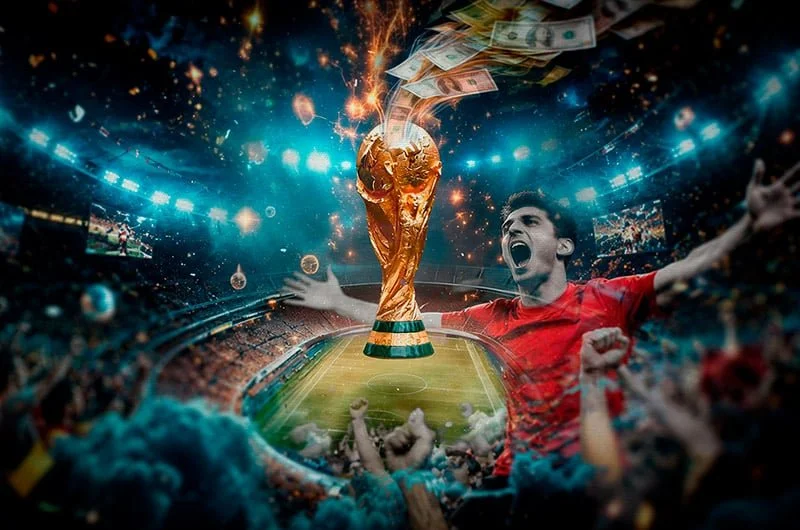
There is a particular sense of pride available for your purchase at the world’s greatest sporting spectacle. For the global upper-middle class, from Jakarta to Buenos Aires, from Cairo to Manila, flying to the United States, Canada, or Mexico to watch a string of 2026 World Cup fixtures represents the pinnacle of a jet-set lifestyle. It is a passport to the highest form of social validation, engineered for real-time broadcast on social media: “Lo and behold for I am a socialite.”
Behind the roar of the crowds, the floodlit arenas, and the gleam of VIP and VVIP tickets lies something colder, more calculated, and more systematic: a macro-scale economic extraction operation. You are not celebrating global diversity or bearing witness to a landmark moment of sporting history in a fractured world. You are voluntarily surrendering your country’s battered foreign exchange reserves to subsidize the fiscal deficit and sustain the military-industrial complex of a superpower.
This is a Macroeconomic Sports-Washing, a form of geopolitical exploitation that does not require the barrel of a gun, but a highly-manufactured hospitality packages.
Jerome Powell and “The Ignorance Tax”
To properly understand this perspective, one must pull their gaze from the green pitch and fix it on the Marriner S. Eccles Building in Washington, D.C., the headquarters of the Federal Reserve. In early June 2026, its architect of monetary policy, Jerome Powell, brought down his gavel to hold interest rates in the range of 3.50% to 3.75%.
To any economist tracking emerging market liquidity, that number functions as a slow death warrant. The United States is currently carrying a national debt of staggering proportions, with interest payments that now exceed its own defense budget. Under normal circumstances, the “higher for longer” rate policy is designed to suppress domestic U.S. inflation. Its side effect, however, is to systematically drain capital from the Global South. Currencies like the Indonesian Rupiah, the Philippine Peso, and the South African Rand are kept under chronic pressure, bleeding the cost of energy imports and industrial development programs in those very same countries.
It is against that fiscal backdrop that the 2026 World Cup, projected to generate over US$10.9 billion in economic activity, a dramatic jump from US$7 billion at Qatar 2022, arrives not as a sporting festival, but as an emergency capital extraction instrument.
When hundreds of thousands of middle-class tourists from developing nations convert their local currencies into U.S. dollars at punishing exchange rates, they are paying what might be called The Ignorance Tax. The money spent on a cup of coffee in Manhattan, an Uber ride in Los Angeles, or a hotel tax in Miami constitutes fresh foreign direct spending are hard liquidity injected directly into the U.S. economy. The tournament effectively pumps billions of dollars into American commercial circulation, stabilizing monetary velocity without the Federal Reserve needing to resort to quantitative easing.
The Algorithm Machine: Dynamic Pricing and Legal Scandal
The extraction does not stop at the currency exchange counter. It extends into the micro-management of the supporter’s wallet. The myth that the World Cup is a common people’s sport is shattered by the algorithmic machinery of American capitalism known as dynamic pricing.
The original promise that the cheapest tickets would be available for as little as US$21 was a public relations facade. In practice, the ticketing system deployed real-time demand-responsive pricing schemes that triggered micro-hyperinflation. Group-stage tickets that should have cost a few hundred dollars rocketed to thousands within minutes of going on sale.
The institutional backlash was swift. In late May 2026, the Attorneys General of New York and New Jersey formally issued subpoenas to FIFA and its partner agencies over evidence of monopolistic practices and consumer price gouging, a rare juridical confrontation that laid bare the architecture of organized financial predation beneath the tournament’s glossy surface.
The hospitality economy confirmed every suspicion. In Los Angeles and Miami, mid-range hotel rooms surged to well above US$480 per night. The global middle class was not purchasing the usual luxury experience. It was being subjected to legalized robbery by algorithms designed to extract every cent of foreign currency that crossed the U.S. border.
Laundering the Deficit in Sporting Colors
If the currency drain is the first irony, the destination of those funds is thesecond, and the darker one.
History may record the 2026 World Cup as a masterpiece of cross-subsidy: from the stage of sport to the machinery of war. This month, the U.S. Mint officially released a commemorative 2026 FIFA World Cup Gold and Silver Coin series. On the surface, it is premium memorabilia coveted by collectors and fans worldwide. But a close reading of the legislation governing U.S. commemorative coin mintage reveals a mandatory surcharge mechanism attached to each coin sold. Under U.S. law, a portion of the profit margin from these collectibles is legally directed to organizations affiliated with American military veterans and military family initiatives.
The irony is grotesque. Millions of supporters from the Middle East, Africa, and Asia, whose countries are frequently subject to U.S. foreign policy interventions, economic sanctions, or direct military engagement, are lining up to purchase football souvenirs. Unwittingly, the middle class of the Global South is unaware financing the military ecosystem of the very power that projects hegemony over their countries. Washington no longer needs to send carrier groups to extract tribute. It only needs to sell coins with soccer logo on them, and the developing world will pay with enthusiasm.
The Moral Rubber Stamp and the Barbed-Wire Border
But no large-scale economic extraction operation runs smoothly without a convincing moral cover story. That is precisely the role FIFA plays: an institutional moral rubber stamp for the foreign policy of Western states.
Under the command of President Gianni Infantino, whose leadership record has consistently favored the largest capital structures, FIFA broadcasts relentless campaigns of “Say No To Racism” and “Football Unites The World.” But the evidence on the ground reveals that the anti-racism campaign is a paid commodity. What frequently goes unnoticed is a form of economic apartheid operating beneath the messaging.
In early June 2026, the hard facts tore through the illusion. The United States’ strict-border and visa regime was deployed as a proxy instrument of geopolitical war. The Iranian national team was, in effect, exiled to Tijuana, Mexico. Following U.S. State Department delays and denials of entry visas, executed amid escalating Washington-Tehran tensions, the Iranian squad was forced to relocate its base camp across the border. The host nation was openly sabotaging a rival’s technical preparation using administrative instruments.
The fear is extended further. The specter of ICE operations near stadium perimeters triggered mass anxiety among visiting fans. Supporters from West African nations reported some of the highest visa rejection rates in the tournament’s history. The message was unambiguous: this World Cup celebrates diversity, but only provided you arrive from a Western-aligned country or can afford VIP access.
FIFA’s double standards reached their most revealing expression in how the organization handles questions of sovereignty. When Russia invaded Ukraine, FIFA required only days to expel Moscow from the global football ecosystem in the name of “humanity.” When the Israeli right-wing government launched a bloody military offensive that destabilized the Middle East, FIFA fell into moral paralysis, retreating behind the stale mantra that “sport must not be mixed with politics.”
When the United States facilitated and armed that same conflict, FIFA unrolled the red carpet, awarded exclusive hosting rights, and, in an act of breathtaking institutional absurdity, presented Donald Trump with a “FIFA Peace Prize.” The conclusion writes itself: FIFA enforces its sovereignty doctrine according to the postal code of geopolitical alliance.
The Landlord and the Artificial Grass
The theater becomes complete when one examines the United States’ own contribution to the sport it is hosting.
Football (or soccer) has historically ranked behind American football, baseball, and basketball in U.S. public consciousness. Yet in 1994, the United States hosted the World Cup and set a record that still stands: 3.5 million tickets sold, the largest attended World Cup in history. It is worth to examine how the 2026 edition would perform under Donald Trump’s administration, which has enacted the most restrictive immigration and visa policies in modern American history.
In 2026, the United States plays a single role: The Landlord. What it is practicing is the most brutal cultural arbitrage of this century. The country is not building a stage to celebrate football; it is renting out real estate. Recent reporting has exposed the fact that local organizing committees declined to construct football-specific stadiums, choosing instead to borrow existing NFL facilities.
To minimize costs, many of these venues have had hybrid synthetic turf installed over their existing surfaces, a condition that materially increases the risk of serious injury to elite athletes. Mechanically, artificial turf does not absorb impact forces the way natural grass does. The foot locks to the surface for longer, transferring rotational stress to the knee and ankle.
FIFA and UEFA have certified hybrid turf as meeting “the highest standards.” But independent research tells a different story:
NFL data shows non-contact knee injuries are 32% more frequent on synthetic turf
Non-contact foot and ankle injuries are 69% higher on artificial surfaces
The American Orthopaedic Society for Sports Medicine found overall injury risk 58% higher on artificial turf compared to natural grass
Whether the Landlord genuinely cares about the knees of players who may be destroyed on its plastic fields is a question worth asking. What is certain is that it cares deeply about maximizing VIP seating capacity to ensure commercial broadcast rights continue generating net profit. It is extracting rent fees from the culture of other nations.
An Expensive Farce That Plays the System
And who performs on that artificial grass? The lead actors of this dark comedy are not Americans. The United States is compelled to import its cultural icons from the periphery: Messi, Ronaldo, Mbappé, Neymar.
These players were forged in the economic hardship of the working class: the rough streets of Latin America, the narrow alleyways on the outskirts of European cities. They represent something real: empathy, social mobility, the one arena where a Third World country can, by pure merit, impose its will upon a wealthy one on equal terms. Football is the sole global stage where the developing world can humble a superpower through pure talent and hard work.
At the 2026 World Cup, that value has been completely hijacked.
These athletic heroes have been reduced to commodity assets; compelled to run, perform, and bleed on artificial turf so that America’s financial oligarchy can sell VIP boxes to elites from developing nations. Players from poorer continents pour out their sweat, while foreign exchange revenues and trillions in net profit flow into Washington’s coffers. If this is not a form of sweatless imperialism, a hegemony without the inconvenience of effort, what else is more proper to address it?
The Landlord has successfully hijacked the world’s stage without contributing a single significant item of cultural heritage. It imports the heroes of the periphery, dresses them as gladiators of the elite, and sits back to count down the foreign currency arriving to patch its fiscal accounts.
The Final Whistle
Ultimately, the 2026 World Cup in the United States is not a pure sporting celebration. It is a performance of global capitalism’s dark comedy, directed with the cold precision of a structural predator. And the cruelest part is this: we are the punchline.
The upper-middle-class consumer who believes themselves sophisticated and exclusive, who willingly queues to exchange an inflation-ravaged currency for algorithm-manipulated tickets, who drains their savings to fly across continents, who buys commemorative coins that subsidize the American war machine, and who screams in ecstatic tribute to cultural heroes being exploited by the very system that is impoverishing their home country; that consumer is the primary subject of this dark comedy.
So when the final whistle blows at the final match in New Jersey, and fireworks beautifully lighting up the American night sky, bear in mind this one inescapable truth: the United States did not need to win the trophy to become the tournament’s champion. It won on the day you exchanged your currency to fly there.
You were never a tourist. You were a fiscal cow to the wealthiest country on earth.