

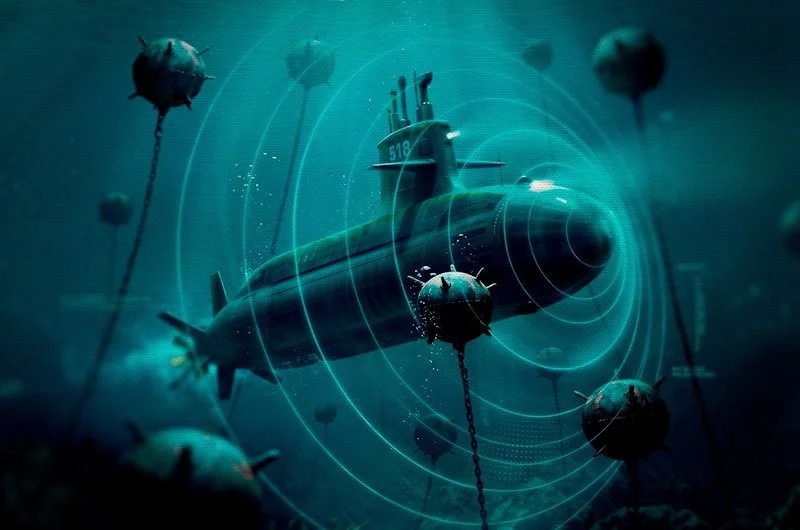
There is a striking irony in Japan’s maritime history. Japan announced its surrender in August 1945. The Imperial Japanese Navy, once among the most formidable naval forces in the world, was subsequently disbanded. Its ships had been sunk, its infrastructure devastated, and a nation that had spent decades defining itself as a maritime power suddenly found itself living under an entirely different strategic order. Japan was no longer thinking in terms of carrier battle groups, ocean-going fleets, or expansion across the Pacific. Instead, one of its most urgent maritime tasks was far less dramatic: clearing mines.
The waters around Japan at the end of the Second World War were littered with tens of thousands of naval mines. Some had been laid by Japan itself to defend its approaches, while others had been deployed by the United States to disrupt Japanese shipping and logistics during the final stages of the war. The fighting had ended, but the sea was still not safe. Ports had to reopen, merchant vessels had to sail again, food had to reach the population, and industry had to be rebuilt. Japan could not recover without access to the sea, and the sea could not fully return to civilian use until the explosives hidden beneath its surface had been removed.
This was the first great paradox of Japan’s postwar maritime recovery. Its capabilities did not begin to re-emerge from an ambition to rebuild a navy. They grew from the practical need to make the surrounding waters usable again. What appeared to be a technical and almost mundane task would gradually create a body of knowledge, discipline, and institutional experience that Japan would continue to refine for decades.
Japan did not return to the sea because it wanted to rebuild a navy. It returned because the sea had to be made safe.
The Minefields
Mine warfare is among the least glamorous forms of naval warfare. There are no dramatic exchanges between capital ships, no spectacular naval gunfire, and few victories that easily lend themselves to heroic narratives. A mine simply waits. Yet precisely because it waits, often unseen and at relatively low cost, it can impose consequences far beyond its physical size. A country does not need to destroy an opposing fleet to disrupt maritime trade. A handful of mines placed in the right waters can make a harbour unusable, delay naval operations, or force merchant shipping to reconsider an entire route.
Clearing mines therefore involves far more than removing dangerous objects from the water. It requires precise navigation, knowledge of magnetic signatures, underwater acoustics, detonation mechanisms, hull design, sensors, disciplined crews, and the ability to carry out highly dangerous work repeatedly without making mistakes. Japan performed this task for years. As the same difficult problem was confronted again and again, necessity became specialisation, and specialisation gradually became expertise.
At a time when many navies were preoccupied with faster ships, larger guns, and increasingly sophisticated weapons, postwar Japan was being forced to master something more fundamental: the ability to understand the maritime environment in extraordinary detail. The country was not rebuilding offensive naval doctrine, but it was accumulating knowledge about the sea, about hidden threats, and about the engineering required to operate safely in complex waters.
When offensive naval ambition was curtailed, technical necessity remained.
In that sense, Japan was rebuilding maritime competence from the bottom up. The process did not begin with grand strategy. It began with engineering.
Korea: When America Needed Japan
Five years after Japan’s surrender, the Korean War brought that expertise into a completely different strategic context. The United States, which led maritime operations around the Korean Peninsula, soon encountered a problem that even overwhelming naval superiority could not easily solve: mines. Around Wonsan in particular, minefields became a serious obstacle to American operations, demonstrating once again that sophisticated fleets could still be constrained by relatively simple weapons placed in the right location.
The United States had larger warships, more aircraft, and vastly greater logistical capacity. None of that made mines irrelevant. This was the moment when expertise developed by Japan out of domestic necessity acquired strategic value. Japanese minesweeping crews were called upon to assist American operations, creating one of the more remarkable reversals of the early postwar period. Only five years earlier, Japan and the United States had fought each other to the point of devastation. Now Washington required Japanese maritime expertise.
The significance of the episode went beyond minesweeping itself. Japan had not returned as a major military power, but it had already developed a highly specialised competence that a much larger power found useful. The Korean War therefore illustrated an important distinction between military power and military competence. A country may lack the ability to project force globally and still possess a capability so mature, technical, and difficult to reproduce that even stronger states come to depend upon it.
Military power had been taken away. Maritime competence had not.
From that point, the strategic question surrounding Japan’s maritime role began to evolve. It was no longer only about how to clear dangerous waters. The next question was who would protect those waters once they had been cleared.
From Minesweepers to Escorts
Japan is an island nation, and that simple geographical fact shapes almost every aspect of its strategic outlook. The sea is not merely a boundary around the country. It is a highway, an energy corridor, and an economic lifeline. It carries raw materials into Japanese factories and transports Japanese goods to markets around the world. As the economy recovered and expanded in the decades after the war, this dependence became even deeper rather than less important.
Sea lanes therefore became part of Japan’s national life support system. Maritime security could not remain a temporary postwar responsibility centred only on mine clearance. A broader institutional structure gradually emerged. The Japan Coast Guard was established, the Coastal Safety Force followed in the early 1950s, and in 1954 the Japan Maritime Self-Defense Force, or JMSDF, was created.
This was not simply the Imperial Japanese Navy returning under another name. The strategic logic was different. The Imperial Japanese Navy had once been built around the question of how far Japan could project power. The JMSDF developed around a more defensive and fundamentally different concern: how to keep the waters around Japan open, secure, and usable.
That change in purpose shaped the capabilities Japan chose to develop. Escort vessels, patrol, surveillance, anti-submarine warfare, mine countermeasures, sensors, and the protection of maritime routes became central to the mission. The sea was no longer primarily a space to be conquered. It was a space that had to remain accessible.
Japan’s lack of abundant natural resources made this maritime vulnerability even more important. Tankers bringing energy, bulk carriers delivering raw materials, and merchant vessels carrying Japanese industrial products were not simply commercial traffic. They were part of the national security equation. Japan consequently rebuilt maritime capability gradually, not through one dramatic leap, but by solving one problem after another.
The School of Silence
The more seriously a country studies the sea, the more quickly it discovers that the most dangerous threats are not always visible. Beneath the surface lies an entirely different operational environment defined by submarines, mines, acoustics, currents, thermal layers, and sonar. For an island nation located between the Pacific Ocean, the Sea of Japan, and the East China Sea, understanding that underwater environment became increasingly important.
During the Cold War, Soviet submarines operated close to Japanese waters. In the twenty-first century, the expansion of Chinese naval power has once again placed underwater awareness at the centre of Japan’s maritime security concerns. Japan responded by deepening its capabilities in anti-submarine warfare, surveillance, sensors, and underwater acoustics.
This is where a distinctive feature of Japanese industrial culture becomes particularly visible. Japan is often admired for creating advanced technologies, but its deeper strength may lie in something less dramatic: the ability to improve existing systems continuously and methodically. A platform becomes slightly quieter, slightly more efficient, able to remain submerged slightly longer, better able to detect sound, or faster at processing information. None of these changes necessarily looks revolutionary when viewed in isolation.
Over twenty, thirty, or forty years, however, the effect is very different. Small improvements accumulate. Ship generations change. Sensors improve. Propulsion systems evolve. Materials become more sophisticated. Noise is reduced and automation expands. At some point, what looks like gradual technical evolution produces a capability that is fundamentally more mature than what existed before.
That is one of the most important characteristics of Japanese engineering. Innovation does not always require reinventing the entire platform. It can also come from identifying imperfection and systematically removing it.
Japan did not innovate by constantly reinventing its ships. It innovated by continuously eliminating their imperfections.
This approach is often described through the Japanese concept of kaizen, but reducing the story to that familiar term risks turning a deeper industrial habit into a cliché. The strategic significance lies in what happens when incremental improvement is sustained across decades. Repeated refinement can eventually become a form of disruptive power in its own right. Instead of relying on one spectacular technological leap, capability is built through the accumulation of thousands of smaller improvements.
From Lead-Acid to Lithium-Ion
Conventional submarines have always operated under a basic compromise. When submerged and powered by electric motors, they can be exceptionally quiet. The problem is energy. Batteries have limits, and eventually the submarine has to recharge them. Every period spent at snorkel depth running diesel engines increases the possibility of detection. For a conventional submarine, therefore, one of the central questions is straightforward: how long can it remain beneath the surface without revealing its presence?
Japan eventually took one of the most important technological steps in the recent evolution of conventional submarines by adopting lithium-ion batteries. Japan introduced lithium-ion batteries aboard the final two Sōryū-class submarines, JS Ōryū (commissioned in 2020) and JS Tōryū (commissioned in 2021). The technology was subsequently carried forward into the Taigei class.
Lithium-ion batteries offer greater energy capacity, stronger discharge performance, faster recharging, and improved underwater endurance. Yet their strategic value is not simply a matter of battery specifications. What matters is what those characteristics allow the submarine to do operationally. The boat can remain submerged for longer periods, reduce the need to approach snorkel depth, and shorten the windows during which it becomes more vulnerable to detection.
The real advantage, therefore, is a longer silent presence.
This is where Japan’s journey from mine clearance to lithium-ion submarines acquires a deeper historical symmetry. In the immediate aftermath of the Second World War, finding hidden underwater threats became a central task of Japan’s maritime recovery. Eight decades later, some of its most sophisticated maritime technologies are designed to make Japanese vessels increasingly difficult to locate in that same environment. Japan once concentrated on finding what could not be seen. Today, some of its finest engineering is devoted to remaining unseen.
Perfection Under Constraint
It would be easy to tell this story simply as a celebration of Japanese technological superiority. That would miss the larger point. Many countries have excellent engineers, sophisticated shipyards, and access to advanced technology. What makes the Japanese experience particularly interesting is the strategic environment in which these capabilities developed.
After the Second World War, Japan operated within far narrower military boundaries than it had before 1945. Those limitations did not automatically create excellence, but they helped shape an environment in which Japan had to make careful choices about which capabilities truly mattered. Over time, a pattern emerged.
Constraint produced focus.
Japan did not have unlimited freedom to develop every category of military capability. Certain areas therefore received sustained and unusually deep attention.
Focus produced repetition.
Mine warfare, escort operations, anti-submarine warfare, underwater acoustics, and submarine technology were not treated as temporary programmes. They were maintained, practised, and developed across generations.
Repetition produced refinement.
Each generation of systems addressed weaknesses discovered in the one before it.
Refinement produced mastery.
After decades, the result was a body of capability that may not always appear spectacular in public headlines, but is deeply respected by those who understand naval warfare.
This stands in contrast to an innovation culture driven primarily by novelty. Some industries constantly ask, “What can we invent next?” The Japanese approach often appears to ask a different question: “What is still imperfect in what we already have?” Both approaches can produce innovation, but they travel different paths. One searches for what has never existed. The other searches patiently for the weakness that still remains.
In naval warfare, where a small acoustic signature can mean the difference between remaining hidden and being detected, that second approach carries enormous strategic value.
The Paradox of Postwar Japan
This, ultimately, is the central paradox of postwar Japan. The restrictions that followed defeat were intended to ensure that the country would not return to the aggressive military posture of its imperial past. Yet history did not stop. The Cold War arrived, the Soviet Union expanded its military presence, China rose, sea lanes became more important, and military technology grew increasingly complex.
Japan gradually rebuilt the means to defend itself, but it did so without attempting to recreate the Imperial Japanese Navy. The process was quieter and more incremental. One problem was addressed, then one technology, then one generation of platforms, followed by another round of refinement. Minesweepers led to broader escort requirements. Maritime defence expanded into anti-submarine warfare. Underwater expertise fed into submarine development, and eventually into the adoption of lithium-ion technology.
Japan’s experience suggests that national power does not always grow through expansion. It can also emerge from limitation. When the number of available choices becomes narrower, attention can become deeper. When that depth of attention is sustained over decades, constraint can produce expertise that is remarkably difficult to reproduce.
None of this means that postwar restraint alone transformed Japan into a master of the maritime domain. History is never that simple. The alliance with the United States, Japan’s geography, industrial strength, investment in technology, regional threats, and engineering culture all shaped the outcome. But constraint helped give the journey its particular form. It helps explain why Japanese maritime capability developed as it did: not always the most aggressive, not always the largest, but often exceptionally mature.
Perhaps that is the most important lesson in Japan’s maritime evolution. Strategic strength does not always come from having the freedom to do everything. Sometimes it comes from performing the same difficult task for decades and becoming slightly better every time.
Japan’s postwar maritime journey began with the effort to clear hidden dangers from its waters. Eight decades later, some of the finest machines Japan builds are designed to remain unseen in that very same place.
Japan’s postwar maritime journey began with the effort to find dangers hidden beneath the sea. Eight decades later, some of its finest submarines are designed to be harder to detect in those same waters.